
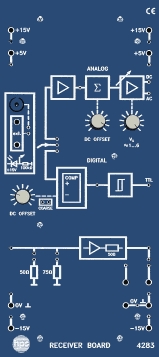
Type 4283
RECEIVER BOARD Type 4283
Type 4283 is the receiver section of the transmission system for fibre optics, infrared and wired-line experiments. Optical and electrical input signals can be evaluated with adjustable amplifiers and output stages. This makes the transmission behaviour easy to analyse directly.
- Receiver board for fibre optics, infrared and lines
- Optical input for plastic and glass fibre
- Electrical input for two-wire and coaxial line
- Amplifier with adjustable gain
- DC and AC outputs plus TTL output
- Schmitt trigger for digital signals
Receiver side
The board represents the receiving side of the system. An optical input, an electrical comparison input and multiple output types allow a detailed analysis of attenuation, waveform and level behaviour.
The adjustable coupling can be used to simulate attenuation on plastic fibres in a controlled way.
Lab applications
The receiver can be combined with the transmitter board Type 4282, the modulation board Type 4280 and the demodulation board Type 4281. This creates complete experimental chains for analogue and digital transmission paths.
Comparison measurements with two-wire and coaxial lines are also possible.
- Adjustable coupling for attenuation simulation
- Optical input
- plastic fibre / glass fibre
- Electrical input
- two-wire or coaxial line
- Input resistance
- 50 Ohm / 75 Ohm
- Output amplifier
- gain 1 ... 6; DC component +0.5 V ... -5.5 V
- Outputs
- DC 0 ... +/-8 V; AC 0 ... 16 V; TTL with Schmitt trigger, fan-out 10
- Plastic fibre coupling
- end-face distance adjustable for attenuation simulation
- Dimensions
- 266 x 297 x 110 mm
- Weight
- 2.0 kg
- Supply
- +15 V / -15 V / +5 V
- Use plastic optical fibres
- Measure transmitter diode characteristics
- Measure attenuation of plastic fibres and connectors
- Transmit TTL signals
- Investigate immunity to noise
- Carry out glass fibre experiments
- Measure propagation time and velocity
- Try infrared transmission
- Study wired transmission with a comparison setup
- Evaluate receiver behaviour and level limits
Taken from the tables of contents of the hps experiment manuals (titles, numbers and pages). All manuals are German; titles are shown in the original language. All manuals and experiments
V 0132 Übertragungsstrecken Manual · 96 pages 19 experiments
Main device of this manual – applies to all experiments Named in the manual as 4283.4 View table of contents
- 2.2 Leistungskennlinien von Sendedioden mentioned p. 13
- 2.3 Dämpfungsmessung an Fasern mentioned p. 17
- 2.4 Dämpfung an Verbindungsstellen mentioned p. 22
- 2.5 Übertragung von Wechselspannung mentioned p. 28
- 2.6 Übertragung von zwei analogen Signalen im Frequenzmultiplex-Betrieb mentioned p. 32
- 2.7 Übertragung frequenzmodulierter Signale p. 37
- 2.8 Übertragung pulsfrequenzmodulierter Signale mentioned p. 43
- 2.9 Übertragung eines PCM-Signals mentioned p. 43
- 3.2 Spektrale Empfindlichkeit des Infrarotempfängers mentioned p. 54
- 3.3 Dämpfung der Übertragungsstrecke (fotometrisches Entfernungsgesetz) p. 56
- 3.4 Abstrahlcharakteristik des Sendemoduls mentioned p. 58
- 3.5 Übertragung von Wechselspannung mentioned p. 62
- 3.6 Übertragung frequenzmodulierter Signale mentioned p. 64
- 3.7 Übertragung eines digitalen Signals in modulierter Betriebsart p. 66
- 3.8 Übertragung eines PCM-Signals p. 68
- 4.2 Anpassung p. 72
- 4.3 Störempfindlichkeit einer Zweidrahtleitung p. 73
- 4.4 Störempfindlichkeit einer Koaxialleitung p. 79
- 4.5 Störstrahlung einer drahtgebundenen Übertragung p. 81
Other sections mentioning this product (1)
No experiment matches the filter.


