
Type 2107
ALARM BOARD Type 2107
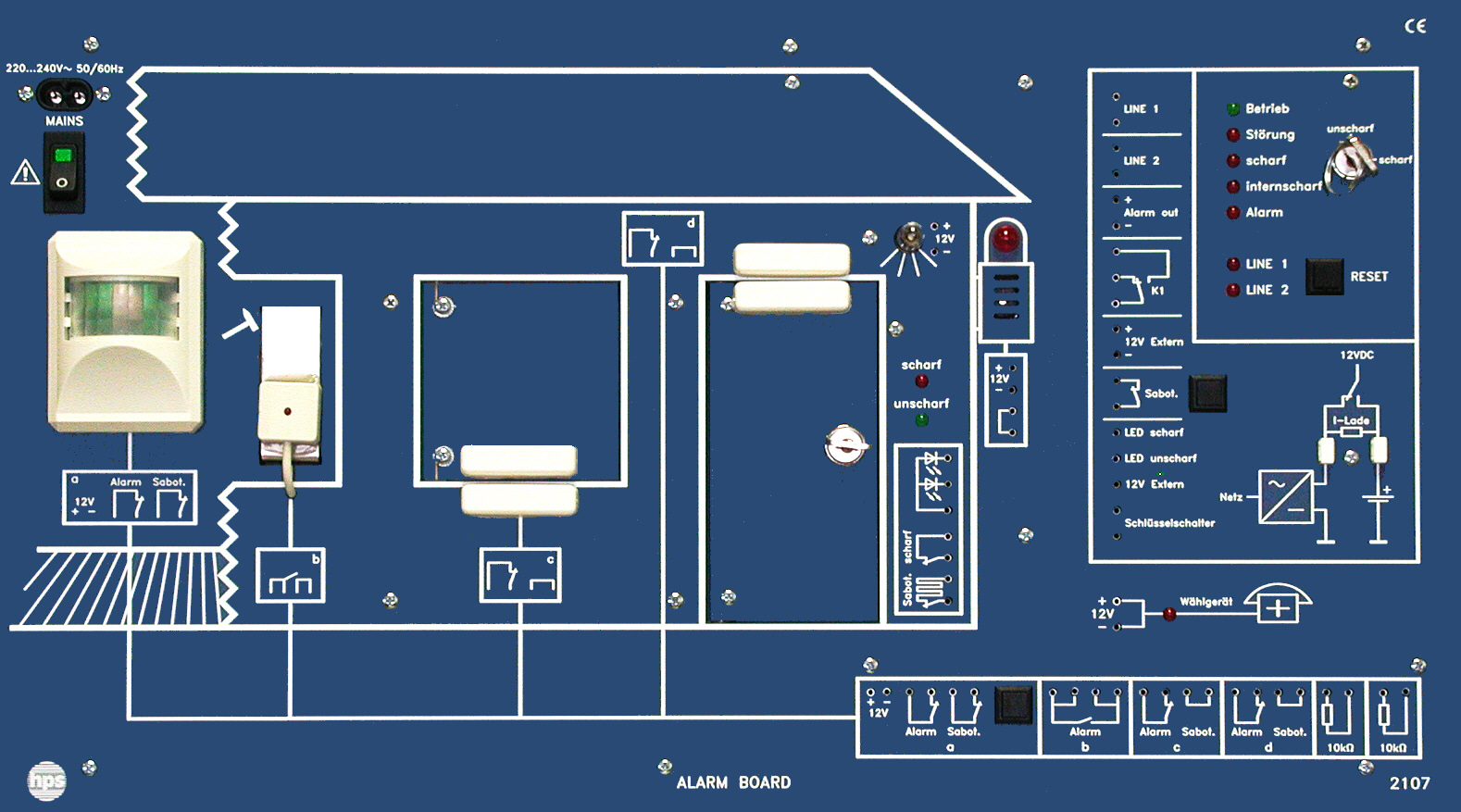
The ALARM BOARD Type 2107 is a complete building alarm system on one board. Original sensors, an integrated alarm centre and signalling devices make the board suitable for practical experiments in security and installation technology. The components are freely wireable and can be commissioned step by step.
- Complete building alarm system on one board
- All individual components freely wireable
- Integrated practice-oriented alarm centre
- Original sensors for building simulation
- Entrance door with key switch and reed contact
- Signalling devices such as outside light, alarm generator and dialler simulation
Building alarm system
Type 2107 represents a complete building alarm system. The individual components can be wired freely and commissioned step by step until the full system is operational.
Original sensors such as a motion detector, glass break detector and reed contact switch make the building simulation highly practical.
Signalling and operation
The integrated alarm centre and the signalling devices with outside light as well as optical and acoustic alarm allow realistic exercises on alarm response and fault finding.
The board is suitable for teaching, laboratory work and examination-oriented training.
- Suitable for examination-oriented exercises
- Mains connection
- 230 V AC / 115 V AC (110 V AC), 50 ... 60 Hz; approx. 10 VA
- PIR motion detector
- 12 V DC
- Glass break detector
- 5 ... 12 V DC, max. 8 mA
- Dialler simulation
- 12 V DC
- Outside light
- 12 V DC / 1 W
- Alarm generator
- 12 V DC
- Alarm centre output
- 12 V DC / 0.2 A
- Connection technology
- 2 mm sockets
- Board dimensions
- 532 x 297 x 140 mm (W x H x D)
- Board weight
- approx. 3.1 kg
- Box version dimensions
- 580 x 450 x 155 mm (W x H x D)
- Total weight with box
- approx. 6.3 kg
- Recommended accessories
- Type 2107.1, V 0112, RMS multimeter
Taken from the tables of contents of the hps experiment manuals (titles, numbers and pages). Titles are translated into English; page references refer to the German manuals. All manuals and experiments
V 0112 Experiments with an intruder alarm system Manual · 66 pages 41 experiments
Main device of this manual – applies to all experiments View table of contents
- 1.1 Break-in points p. 5
- 1.2 Burglary methods p. 6
- 1.3 Burglary duration p. 6
- 1.4 Mechanical safety devices p. 6
- 1.5 VdS and police guidelines p. 7
- 3.1 Strike plate contacts p. 19
- 3.2 Magnetic contacts p. 19
- 3.3 Shock detector p. 20
- 3.4 Alarm films and alarm glass p. 20
- 3.5 Terminating resistor p. 20
- 3.6 Glass break detector p. 21
- 3.7 Seismic detector p. 17
- 3.8 Opening detector p. 22
- 3.9 Hold-up alarm detectors p. 23
- 3.10 Thread pull contacts p. 23
- 3.11 Picture protection detectors p. 24
- 3.12 Capacitive field change detectors p. 24
- 3.13 Light barriers p. 25
- 3.14 PIR motion detector p. 26
- 3.15 Ultrasonic motion detector p. 29
- 3.16 Microwave motion detector p. 29
- 3.17 Dual motion detector p. 30
- 3.18 Alarm tread mats p. 30
- 3.19 Acoustic and visual signaling devices p. 31
- 3.20 Transmission devices p. 31
- 3.21.1 Block lock p. 32
- 3.21.2 Key switch p. 33
- 3.21.3 Code-operated arming device p. 33
- 3.22 Intruder alarm control panel p. 34
- 3.23 Graphic symbols p. 35
- 4.1 PIR motion detector p. 36
- 4.2 Glass breakage sensor p. 38
- 4.3 Magnetic contacts p. 39
- 4.4 External key switch p. 41
- 5.1 Operating detector circuits p. 39
- 5.2 Possible faults in the intruder alarm control panel p. 45
- 5.3 Switch-on and alarm delay p. 47
- 5.4 Arming with an external key switch p. 49
- 6.1 Intruder alarm system – example 1 p. 52
- 6.2 Intruder alarm system – example 2 p. 53
- 6.3 Intruder alarm system – example 3 p. 54
No experiment matches the filter.


