
Type 1040
PHOTOVOLTAIC BOARD Type 1040 / SOLAR PANEL Type 1041
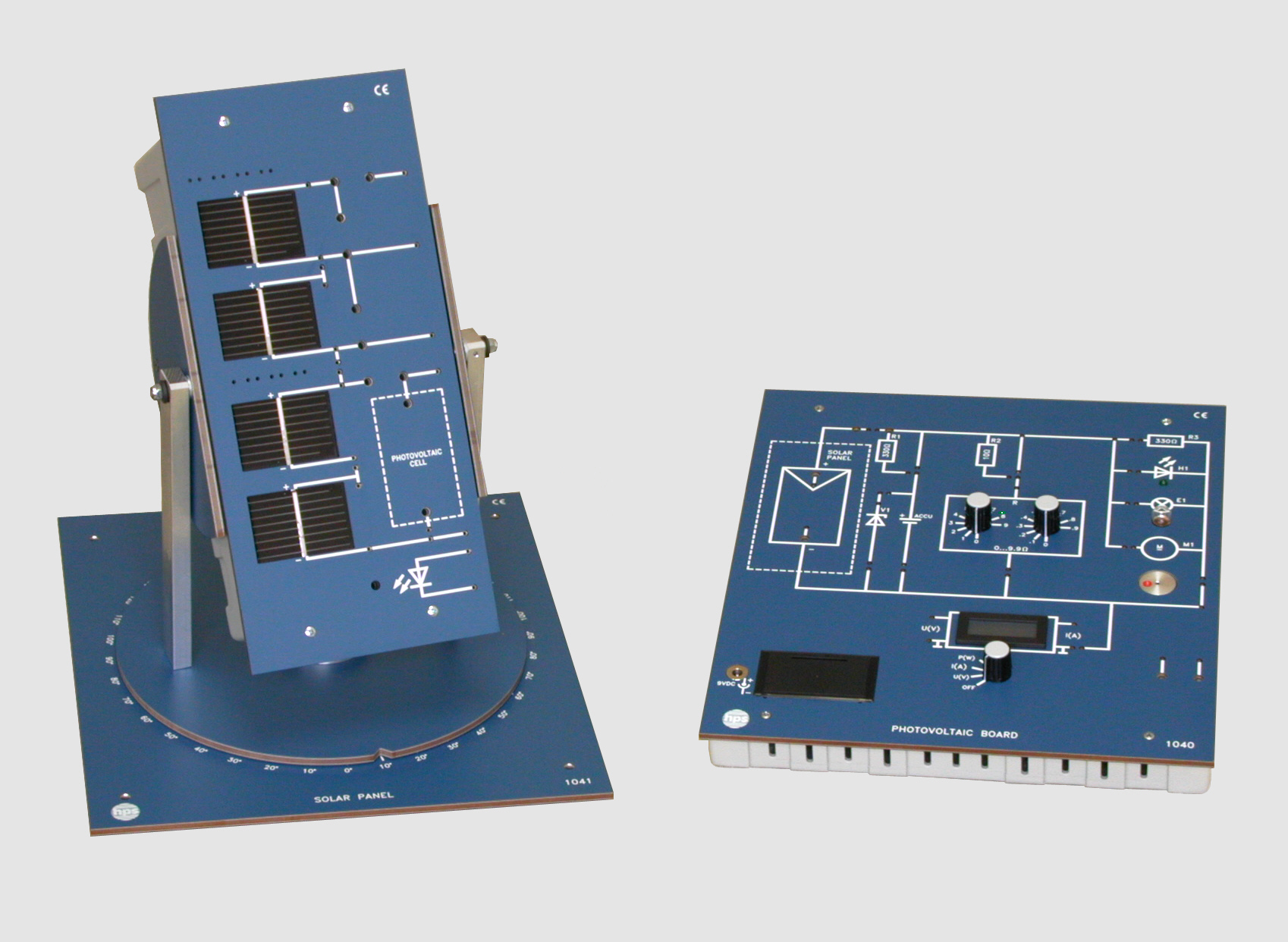
The PHOTOVOLTAIC BOARD Type 1040 with the SOLAR PANEL Type 1041 is a stand-alone photovoltaic training system. Experiments can be carried out with natural sunlight or with a lamp in the lab, while current, voltage and power measurement are integrated directly into the board.
- Stand-alone training system for photovoltaics
- Experiments possible with natural sunlight or with a laboratory lamp
- Tilt and rotation angle of the SOLAR PANEL can be set precisely via printed scales
- String and bypass diodes can be plugged directly onto the SOLAR PANEL
- PHOTOVOLTAIC BOARD with resistance decade, four loads and gold-cap energy storage
- Integrated meter for current, voltage and power
Training system setup
The training system combines the PHOTOVOLTAIC BOARD Type 1040 with the SOLAR PANEL Type 1041 into a compact laboratory solution for the fundamentals of photovoltaics.
Experiments can be performed either with natural sunlight or with a separate lamp. The printed scales make it possible to set the tilt and rotation angle of the SOLAR PANEL reproducibly.
Board, panel and load side
The PHOTOVOLTAIC BOARD contains a resistance decade for recording load curves, four different loads and an energy storage section based on a gold cap.
String and bypass diodes are plugged directly onto the SOLAR PANEL, allowing shading, wiring and module behaviour to be reproduced under realistic conditions.
Accessories and expansion
Accessories include the Type 1042 lamp for indoor work, the additional solar module Type 1041.1, the connection technology set Type 1040.1 and the accessory set Type 1040.2.
Workbook V 0107 extends the system with a complete theory, experiment and solution section for photovoltaic training.
- Expandable with lamp Type 1042, solar module Type 1041.1 and accessory set Type 1040.2
- Workbook V 0107 available for structured photovoltaic experiments
- PHOTOVOLTAIC BOARD Type 1040
- Resistance decade 0 ... 9.9 ohms in 0.1-ohm steps and 10 ... 19.9 ohms with 10-ohm series resistor; 4 loads: 330-ohm resistor, green LED, incandescent lamp 3.8 V / 70 mA, solar motor 5.9 V / 50 mA
- Energy storage
- 1 F gold cap with 1.5 V Z diode for voltage limitation and 330-ohm charging resistor
- Integrated meter
- Voltage 0 ... 19.99 V; current 0 ... 1.999 A; power 0 ... 1.999 W
- Meter supply
- 9 V DC via battery or external plug-in power supply
- Board dimensions
- 266 x 297 x 110 mm (W x H x D)
- Board weight
- approx. 1.4 kg
- SOLAR PANEL Type 1041
- Tilting and rotating mount with angle scale; 4 monocrystalline solar cells Voc 0.6 V / Isc 0.54 A, 1 additional slot for a solar cell, 1 clear LED
- Panel dimensions
- 266 x 297 x 350 mm (W x D x H)
- Panel weight
- approx. 1.95 kg
- Lamp Type 1042
- 230 V / 120 W (PAR 38), 133 x 297 x 210 mm, approx. 1.25 kg
- Solar module Type 1041.1
- Polycrystalline solar cell Voc 0.55 V / Isc 0.43 A for insertion into the SOLAR PANEL, 60 x 70 x 31 mm, approx. 50 g
- Shared mechanical data
- Front panels made of 5 mm laminated insulating material, matt blue with white print; rear side covered by grey plastic housing
- Recommended accessories
- Workbook V 0107, connection technology set Type 1040.1, accessory set Type 1040.2, lamp Type 1042, solar module Type 1041.1
- 1 Fundamentals of photovoltaics1
- 1.1 The sun as a gigantic energy source1
- 1.2 Structure of a solar cell4
- 1.3 Types and manufacturing processes of solar cells4
- 1.3.1 Monocrystalline silicon solar cells5
- 1.3.2 Multicrystalline silicon solar cells5
- 1.3.3 Amorphous silicon solar cells6
- 1.4 Efficiencies of solar cells7
- 1.5 The LED as a photo element8
- 2 Measurement of radiation energy10
- 2.1 Measurement methods10
- 2.1.1 Thermovoltage10
- 2.1.2 Photoelectric method12
- 2.1.3 Spectrometer13
- 2.1.4 Calorimetric method13
- 2.2 Measurement procedures with the hps photovoltaic system14
- 2.2.1 Direct method14
- 2.2.2 Indirect method14
- 2.3 The term air mass15
- 2.4 The term time18
- 2.5 Direct and indirect radiation18
- 3 Investigation of solar cells19
- 3.1 Open-circuit voltage and short-circuit current at different illumination levels19
- 3.2 Open-circuit voltage and short-circuit current with partially shaded solar cell21
- 3.3 Power characteristics of solar cells23
- 3.3.1 Fundamentals23
- 3.3.2 Current, voltage, power, fill factor and efficiency of a monocrystalline silicon solar cell24
- 3.3.3 Current, voltage, power, fill factor and efficiency of a multicrystalline silicon solar cell26
- 3.4 Influence of temperature on short-circuit current and open-circuit voltage28
- 3.4.1 Fundamentals28
- 3.4.2 Temperature influence on a monocrystalline silicon solar cell29
- 3.5 Influence of the angle of incidence on solar cell output31
- 3.5.1 Fundamentals31
- 3.5.2 Output and short-circuit current at different tilt angles34
- 3.5.3 Short-circuit current at different tilt and azimuth angles36
- 3.6 Influence of contamination on solar cell output38
- 4 Interconnecting solar cells into modules39
- 4.1 Series connection39
- 4.2 Parallel connection42
- 4.3 Mixed connection44
- 4.4 Bypass diodes46
- 4.4.1 Fundamentals46
- 4.4.2 Influence of shading on short-circuit current47
- 4.4.3 Voltage at a solar cell under shading49
- 4.4.4 Verification of the effect of bypass diodes50
- 4.4.5 Eliminating the hot-spot effect with a bypass diode51
- 4.5 String diodes53
- 5 DC stand-alone systems55
- 5.1 Load and consumers55
- 5.1.1 General55
- 5.1.2 Load matching55
- 5.2 Energy storage57
- 5.2.1 Fundamentals57
- 5.2.2 The energy storage unit of the PHOTOVOLTAIC BOARD59
- 5.2.3 Operating loads from a battery61
- 5.3 Deep-discharge protection62
- 5.4 Charge controller63
- 5.4.1 Fundamentals63
- 5.4.2 Deep-discharge protection64
- 5.4.3 Exercises64
Taken from the tables of contents of the hps experiment manuals (titles, numbers and pages). All manuals are German; titles are shown in the original language. All manuals and experiments
V 0107 Versuche zur Photovoltaik Manual · 90 pages 31 experiments
Main device of this manual – applies to all experiments View table of contents
- 2.1.1 Thermospannung p. 10
- 2.1.2 Photoelektrische Methode p. 12
- 2.1.3 Spektrometer p. 13
- 2.1.4 Kalorische Methode p. 13
- 2.2.1 Direktes Verfahren p. 14
- 2.2.2 Indirektes Verfahren p. 14
- 2.3 Der Begriff „Air Mass“ p. 15
- 2.4 Der Begriff „Zeit“
- 2.5 Direkte und indirekte Strahlung p. 18
- 3.1 Leerlaufspannung und Kurzschlussstrom bei unterschiedlichen Beleuchtungsstärken p. 19
- 3.2 Leerlaufspannung und Kurzschlussstrom bei teilweise abgeschatteter Solarzelle p. 21
- 3.3.2 Strom, Spannung, Leistung, Füllfaktor und Wirkungsgrad einer monokristallinen Silizium-Solarzelle p. 24
- 3.3.3 Strom, Spannung, Leistung, Füllfaktor und Wirkungsgrad einer multikristallinen Silizium-Solarzelle p. 26
- 3.4.2 Temperatureinfluss auf eine monokristalline Silizium-Solarzelle p. 29
- 3.5.2 Leistung und Kurzschlussstrom bei unterschiedlichem Neigungswinkel p. 34
- 3.5.3 Kurzschlussstrom bei unterschiedlichem Neigungs- und Azimutwinkel p. 36
- 3.6 Einfluss von Verschmutzung auf die Leistung einer Solarzelle p. 38
- 4.1 Reihenschaltung p. 39
- 4.2 Parallelschaltung p. 42
- 4.3 Gemischte Schaltung p. 44
- 4.4.2 Einfluss der Abschattung auf den Kurzschlussstrom p. 47
- 4.4.3 Spannung an einer Solarzelle bei Abschattung p. 49
- 4.4.4 Nachweis der Wirkung von Bypass-Dioden p. 50
- 4.4.5 Beseitigung des Hot-Spot-Effekts durch eine Bypass-Diode p. 51
- 4.5 Strangdioden p. 53
- 5.1.2 Lastanpassung p. 55
- 5.2.2 Der Energiespeicher des PHOTOVOLTAIC BOARD p. 59
- 5.2.3 Betrieb von Verbrauchern an einem Akku p. 61
- 5.3 Entladeschutz p. 62
- 5.4.2 Tiefentladeschutz p. 64
- 5.4.3 Übungen p. 64
No experiment matches the filter.


