
Type 1014.2
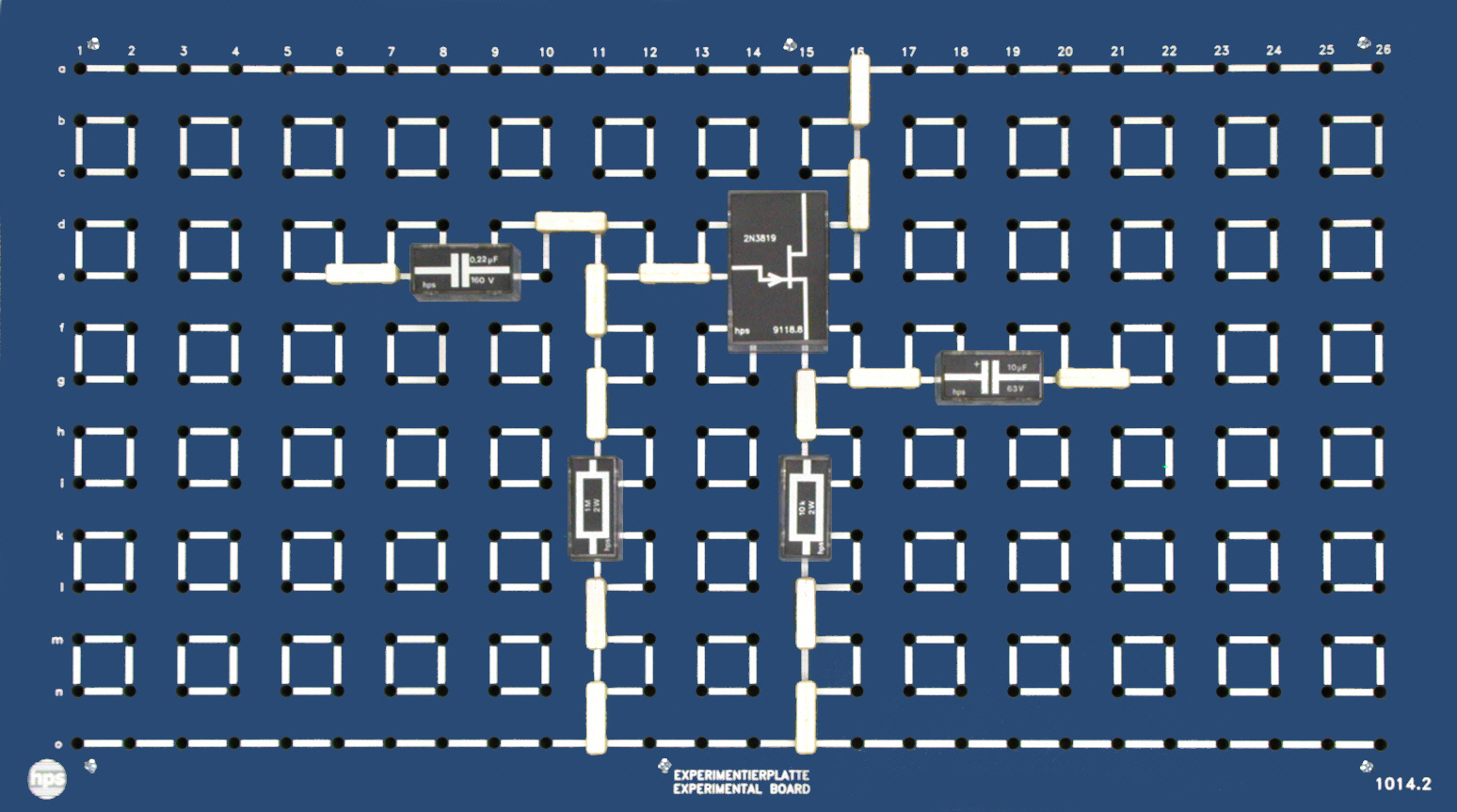
Type 1014.2 Experimental Board
The Type 1014.2 Experimental Board is a robust universal setup plate for basic experiments in electrical engineering and electronics. It is suitable for 4 mm safety leads and provides a clear, load-resistant socket grid for practical laboratory and classroom use.
- For basic experiments in electrical engineering and electronics
- 4 mm sockets in a 19 mm grid
- Suitable for 4 mm safety leads
- High contact load capacity
- Rugged mechanical construction
- Suitable for student exercise, training and demonstration areas
Application and Layout
In combination with the plug-in components from hps SystemTechnik, the experimental board enables solder-free setup of simple circuits for electrical engineering and electronics.
It is suitable for demonstration stations as well as student exercise and training workplaces and can be mounted in frame stands or used directly at the workbench.
The 4 mm sockets are arranged in a 19 mm grid and provide a clear and durable experimental layout.
Mechanical Design
The board features a rugged mechanical design and a high contact load capacity.
The front panel is made of matte-blue laminated press material with white printing and is designed for intensive training use.
Experiment Manual and Contents
The product comes with experiment manual V 0105 including a table of contents. The manual covers the basic experiments in electrical engineering and electronics in multiple chapters and is available as a separate PDF.
- Front panel
- 5 mm laminated press material, matte blue, white print
- Contact load
- max. 10 A
- Transition resistance
- < 0.03 Ohm
- Socket grid
- 4 mm sockets in a 19 mm grid
- Usage
- suitable for 4 mm safety leads
- Dimensions
- 532 x 297 x 90 mm (W x H x D)
- Weight
- approx. 2.3 kg
- 1 Electric Circuit1
- 2 Ohm's Law7
- 3 Voltage and Current Fault Circuit11
- 4 Electrical Resistors13
- 4.1 Fundamentals13
- 4.2 Linear Resistor15
- 4.3 NTC Resistor (thermistor)17
- 4.4 PTC Resistor (cold conductor)19
- 4.5 Photoresistor (LDR)21
- 4.6 Series connection of resistors23
- 4.7 Parallel connection of resistors25
- 4.8 Combination of series and parallel connection27
- 4.9 Unloaded voltage divider30
- 4.10 Loaded voltage divider31
- 5 Equivalent Voltage Source33
- 6 Series Connection of Voltage Sources37
- 7 Parallel Connection of Voltage Sources39
- 8 Electrical Power and Work41
- 9 Efficiency of Electrical Power46
- 10 Voltage, Current and Power Matching47
- 11 Determination and Representation of Parameters in AC Technology49
- 11.1 Fundamentals49
- 11.2 Parameters of the sinusoidal voltage49
- 11.3 Active power with sinusoidal voltage53
- 11.4 Parameters of the square-wave AC voltage57
- 12 Three-phase AC (Three-phase system)61
- 12.1 Fundamentals61
- 12.2 Voltage profile in three-phase systems63
- 12.3 Consumers in star connection67
- 12.4 Consumers in delta connection71
- 12.5 Measurements on a faulty star connection75
- 12.6 Measurements on a faulty delta connection79
- 13 Capacitor in AC Circuits83
- 13.1 Fundamentals83
- 13.2 Charging and discharging of a capacitor85
- 13.3 Phase shift between current and voltage at the capacitor89
- 13.4 Capacitive reactance of a capacitor91
- 13.5 Series connection of capacitors93
- 13.6 Parallel connection of capacitors95
- 13.7 Reactive power of a capacitor97
- 14 Coil in AC Circuits101
- 14.1 Fundamentals101
- 14.2 Switching on and off a coil103
- 14.3 Phase shift between current and voltage at a coil107
- 14.4 Inductive reactance of a coil109
- 14.5 Series connection of coils111
- 14.6 Parallel connection of coils113
- 14.7 Reactive power of a coil115
- 15 Combination of Resistor, Capacitor and Coil119
- 15.1 Fundamentals119
- 15.2 Series connection of resistor and capacitor119
- 15.3 Parallel connection of resistor and capacitor123
- 15.4 Series connection of resistor and coil127


