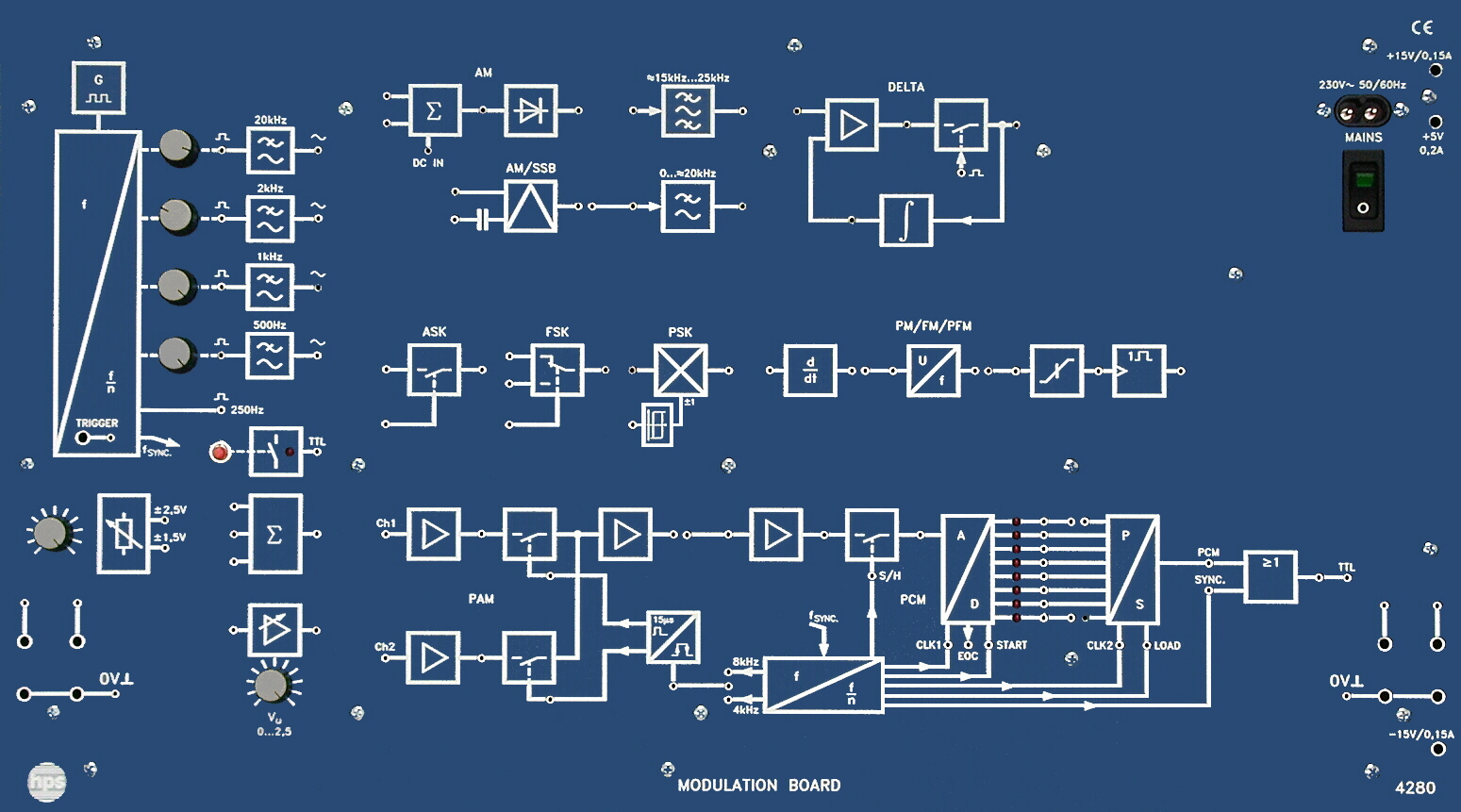
Type 4280
MODULATION BOARD Type 4280
Type 4280 combines the important modulation methods on one board. An integrated short-circuit-proof signal source and synchronised power supply reduce setup time significantly. The system is designed for combined work with the demodulation board.
- All important modulation methods on one board
- Integrated short-circuit-proof signal source
- Built-in power supply for external setups
- Synchronised carrier and modulation frequencies
- Stable oscilloscope displays through internal supply
- Expandable with demodulation board Type 4281
Modulation methods
The board covers analogue, digital and pulse modulation methods. AM, SSB, FM, PM, PAM, PCM, PFM, PPM, DM, ASK, FSK and PSK can all be set up directly in the lab.
The integrated sources make it easier to compare the different methods under stable measurement conditions.
Lab use
The coupled carrier and modulation signals make reproducible oscilloscope displays possible. This makes the board suitable for beginners as well as more advanced exercises in communication engineering.
In combination with the demodulation board, complete transmission paths can be built and analysed.
- Mains supply
- 230 V AC / 115 V AC (110 V AC); 50 ... 60 Hz; 50 VA
- Output voltages
- +/-15 V / 0.15 A and +5 V / 0.2 A for external transmission paths and noise sources
- Signal source
- Ue ss < 5 V
- Filter range
- band-pass 15 ... 25 kHz; low-pass 0 ... 20 kHz
- Adapter field
- 4 mm to 2 mm sockets
- Board dimensions
- 532 x 297 x 90 mm
- Board weight
- 3.6 kg
- Box dimensions
- 580 x 450 x 155 mm
- Box weight
- 6.8 kg
- Recommended accessories
- Accessory set Type 4280.1, demodulation board Type 4281, transmitter board Type 4282, receiver board Type 4283 and manual V 0131
- Theoretical basics of modulation technology
- Addition and multiplication
- Amplitude modulation and AM-SSB
- Angle modulation methods FM and PM
- Digital modulation methods ASK, FSK and PSK
- Pulse modulation and the sampling theorem
- Pulse code modulation and PCM multiplexing
- Delta modulation
- Solution section and appendix