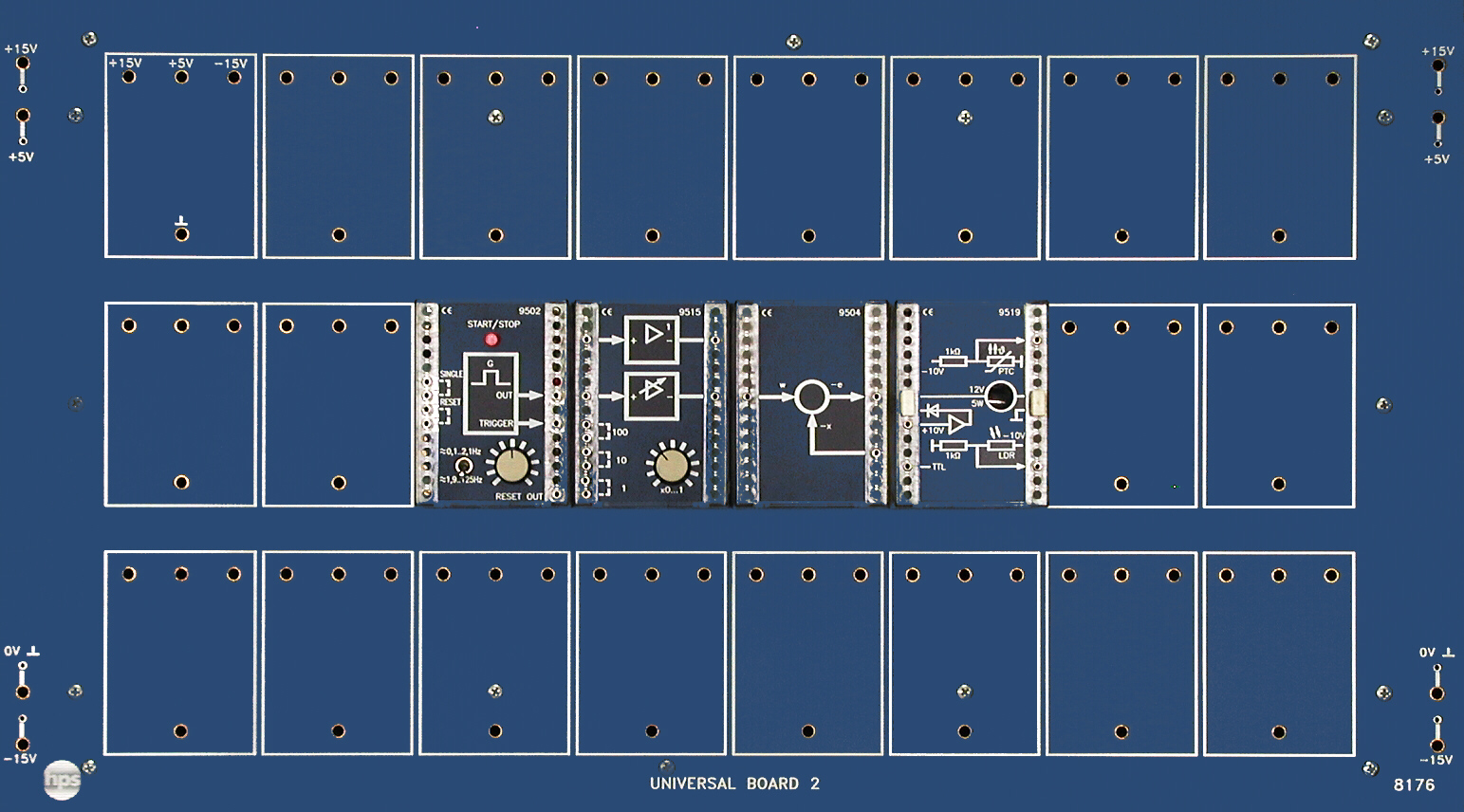
Type 9500
Module System Control Engineering (Series 9500)
The Module System Control Engineering Series 9500 is a modular training system for the fundamentals of control engineering. Only the modules required for the experiment are plugged in, which keeps the setup clear and the measurements reproducible.
- Modular training system for control engineering
- 16 plug-in modules from Type 9501 to 9519
- Usable with UNIVERSAL BOARD 1 and 2
- Central operating voltage supply for fast setup
- Pre-trigger and cyclic measurement for reproducible signals
- Expandable with MOTOR BOARD, SERVO BOARD and the temperature/brightness control system
Application and measurement concept
The Module System Control Engineering was developed for introductory and advanced experiments in control engineering. It consists of plug-in modules that are inserted into UNIVERSAL BOARD 1 (Type 8175) or UNIVERSAL BOARD 2 (Type 8176) depending on the experiment.
The control-loop elements are designed so that their step response can be measured with a standard oscilloscope, a storage oscilloscope or a Y-t recorder. The sequence control discharges the capacitors involved before each cycle and uses a pre-trigger circuit to ensure a complete signal display.
Modules and board variants
The system includes 16 modules, among them the setpoint generator, sequence control, P, I, D and PI controllers, the two-step controller, limiter, summator, delay elements and the temperature/brightness control module.
The UNIVERSAL BOARDs are split into 12 and 24 slots respectively and provide central power routing. The system can also be combined with the POWER BOARD, MOTOR BOARD, SERVO BOARD and the temperature and brightness controlled system.
- Setpoint generator Type 9501
- Sequence control Type 9502
- P controller Type 9505
- I controller Type 9506
- D controller Type 9507
- PI controller Type 9508
- Two-step controller Type 9509
- Limiter Type 9510
- Summator Type 9514
- Amplifier / inverter Type 9515
- Temperature and brightness control module Type 9519
Manuals and accessories
The system is accompanied by the experiment manual 'Introduction to Control Engineering' Type V 0120. The supplementary manual Type V 0122 covers controlled systems and control loops.
Recommended accessories include the accessory set Type 5125.1 with connection leads and plugs and the power supply Type 1002.1.
- Detailed experiments in manual Type V 0120
- Additional manual Type V 0122 for controlled systems and control loops
- Module count
- 16
- Plug diameter
- 4 mm
- Plug arrangement
- 19 mm grid
- Module supply
- +/-15 V DC
- Module housing
- 75 x 56 x 35 mm (w x d x h)
- Module weight
- approx. 0.1 kg
- UNIVERSAL BOARD 1 (8175)
- 12 slots with 4 sockets each, 266 x 297 x 90 mm, 1.33 kg
- UNIVERSAL BOARD 2 (8176)
- 24 slots with 4 sockets each, 532 x 297 x 90 mm, 2.65 kg
- Experiment mode
- repeat frequencies up to about 125 Hz, pre-trigger and cyclic measurement
- Power routing
- central via 2 mm or 4 mm sockets; fourth socket for +5 V
- Recommended accessories
- Accessory set 5125.1, power supply 1002.1, manuals V 0120 and V 0122
- 1 Characteristics of the speed control system3
- 2 Characteristics of the temperature and brightness control system17
- 3 The motor with current or torque control25
- 4 Speed control37
- 5 Voltage control with a machine generator47
- 6 Speed control with subordinate current control55
- 7 DC motor on uncontrolled and controlled single-phase half-wave rectifier75
- 8 Four-quadrant operation of a DC motor with a thyristor converter87
- 9 Four-quadrant operation with an H-bridge103
- 10 Electronic load119
- 11 Temperature control with P and PI controller125
- 12 Temperature control with a two-point controller135
- 13 Temperature control with PID controller and pulse group control143
- 14 Brightness control with P, PI and PID controller149
- 15 Bode diagram, Nyquist plot and controllability of a P-T3 system155
- 16 Matching and smoothing of actual values173
- 17 Characteristics and operating behavior of the servo control system183
- 18 Position control189
- 19 Position control with influencing variables197